
INTERMAG RESISTAR

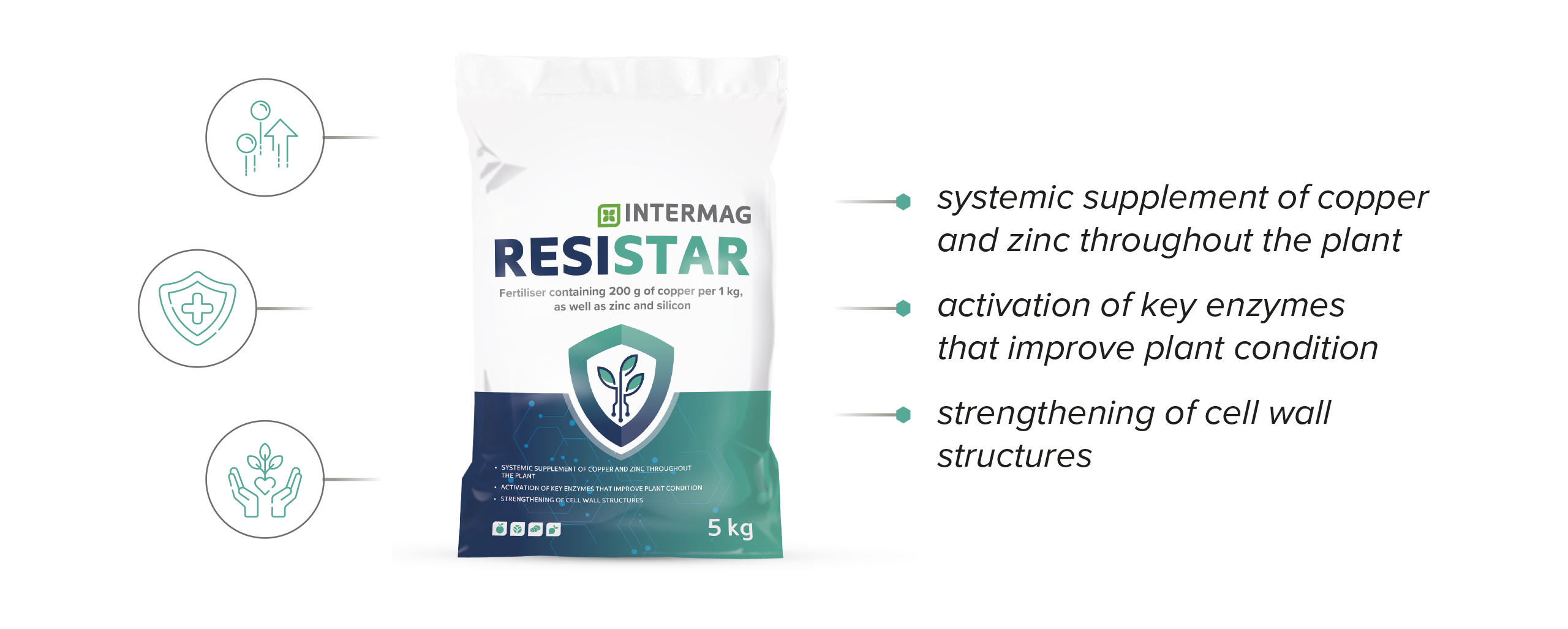
INTERMAG RESISTAR is a activator containing systemic copper and zinc, as well as silicon in the bioavailable and highly absorbable duoSIL® formula.
INTERMAG RESISTAR – BENEFITS
INTERMAG RESISTAR activates and strengthens natural plant mechanisms. Thanks to organic complexes in the form of GCAA, copper and zinc are absorbed and transported very effectively to various plant organs, ensuring action throughout the plant rather than only at the application site. The presence of silicon in the duoSIL® formula increases both mechanical and biological resistance to stress factors.
INTERMAG RESISTAR – COMPOSITION
| CONTENT OF NUTRIENT | g/kg |
| Copper (Cu) | 200 |
| Zinc (Zn) | 40 |
| Silicon (Si), expressed as (SiO2) | 6,4 |
INTERMAG RESISTAR – APPLICATION
INTERMAG RESISTAR is recommended for use in all agricultural, fruit and vegetable crops as foliar applications.
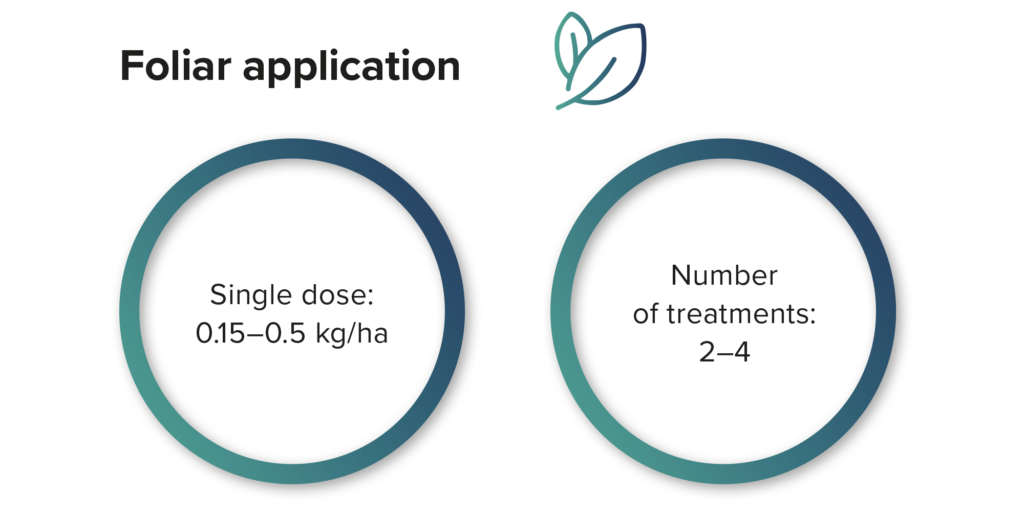
INTERMAG RESISTAR® is intended for foliar application in the form of an aqueous solution. INTERMAG RESISTAR can be used together with other agrochemicals after conducting a miscibility test. Miscibility tests results: Mixing Table – Intermag
CROP GUIDES
| Application times for foliar treatments (◆ optimal, ◇ optional): | Direction for use: |
| ◆ Spring: tillering | Foliar treatments – single dose 0.1–0.6 kg/ha |
| ◇/◆ stem elongation The application time should be considered as optimal in case of when varieties with a tendency to lodging are grown, as well as on soils with high nitrogen fertilization and on soils with pH above 6.5 with a large amount of organic matter content. In addition, copper increases resistance to blade base diseases. |
|
| ◇ flag leaf stage / beginning of heading |
| Application times for foliar treatments (◆ optimal, ◇ optional): | Direction for use: |
| ◆ leaf development – tillering | Foliar treatments – single dose 0.1–0.6 kg/ha |
| ◇/◆ stem elongation The application time should be considered as optimal in case of when varieties with a tendency to lodging are grown, as well as on soils with high nitrogen fertilization and on soils with pH above 6.5 with a large amount of organic matter content. In addition, copper increases resistance to blade base diseases. |
| Application times for foliar treatments (◆ optimal, ◇ optional): | Direction for use: |
| ◇ Autumn: 3–6 leaves unfolded | Foliar treatments – single dose 0.1–0.6 kg/ha |
| ◆ Spring: continuation of tillering | |
| ◇/◆ stem elongation The application time should be considered as optimal in case of when varieties with a tendency to lodging are grown, as well as on soils with high nitrogen fertilization and on soils with pH above 6.5 with a large amount of organic matter content. In addition, copper increases resistance to blade base diseases. |
| Application times for foliar treatments (◆ optimal, ◇ optional): | Direction for use: |
| ◆ leaf development – tillering | Foliar treatments – single dose 0.1–0.6 kg/ha |
| ◇/◆ stem elongation The application time should be considered as optimal in case of when varieties with a tendency to lodging are grown, as well as on soils with high nitrogen fertilization and on soils with pH above 6.5 with a large amount of organic matter content. In addition, copper increases resistance to blade base diseases. |
| Application times for foliar treatments (◆ optimal, ◇ optional): | Direction for use: |
| ◇ Autumn: leaf development – until beginning of tillering | Foliar treatments – single dose 0.1–0.6 kg/ha |
| ◇/◆ Spring: beginning of stem elongation The treatment should be considered as optimal in case of varieties with a high yielding potential, prone to lodging. |
|
| ◆ flag leaf stage – until first awns visible |
| Application times for foliar treatments (◆ optimal, ◇ optional): | Direction for use: |
| ◇/◆ leaf development – until beginning of stem elongation The treatment should be considered as optimal in case of varieties with a high yielding potential, prone to lodging. |
Foliar treatments – single dose 0.1–0.6 kg/ha |
| ◆ flag leaf stage – until first awns visible |
| Application times for foliar treatments (◆ optimal, ◇ optional): | Direction for use: |
| ◇/◆ leaf development – until beginning of stem elongation The treatment should be considered as optimal in case of varieties with a high yielding potential, prone to lodging. |
Foliar treatments – single dose 0.1–0.6 kg/ha |
| ◆ flag leaf stage – until first awns visible |
<table class=”table table-bordered table-striped” border=”1″ cellspacing=”1″ cellpadding=”0″>
<tbody>
<tr>
<td style=”width: 60%;”>Application times for foliar treatments (◆ optimal, ◇ optional):</td>
<td style=”width: 40%;”>Direction for use:</td>
</tr>
<tr>
<td style=”width: 60%;”>◇ Autumn: leaf development – until beginning of tillering</td>
<td style=”width: 40%;” rowspan=”3″>Foliar treatments – single dose 0.1–0.6 kg/ha</td>
</tr>
<tr>
<td style=”width: 60%;”>◇/◆ Spring: beginning of stem elongation
<small>The treatment should be considered as optimal in case of varieties with a high yielding potential, prone to lodging.</small></td>
</tr>
<tr>
<td style=”width: 60%;”>◆ flag leaf stage – until first awns visible</td>
</tr>
</tbody>
</table>
| Application times for foliar treatments(◆ optimal, ◇ optional): | Direction for use: |
| ◇ Autumn: leaf development – until beginning of tillering | Foliar treatments – single dose 0.1–0.6 kg/ha |
| ◇/◆ Spring: beginning of steam elongation The treatment should be considered as optimal in case of varieties with a high yielding potential, prone to lodging. |
|
| ◇ flag leaf stage – until beginning of heading |
| Application times for foliar treatments (◆ optimal, ◇ optional): | Direction for use: |
| ◇/◆ leaf development – until beginning of steam elongation The treatment should be considered as optimal in case of varieties with a high yielding potential, prone to lodging. |
Foliar treatments – single dose 0.1–0.6 kg/ha |
| ◇ flag leaf stage – until beginning of heading |
| Application times for foliar treatments (◆ optimal, ◇ optional): | Direction for use: |
| ◇ leaf development – tillering | Foliar treatments – single dose 0.1–0.6 kg/ha |
| ◇ stem elongation – until flag leaf stage |
| Application times for foliar treatments (◆ optimal, ◇ optional): | Direction for use: |
| ◇ Spring: beginning of main stem elongation | Foliar treatments – single dose 0.1–0.6 kg/ha |
| ◇ bud formation – until beginning of flowering |
| Application times for foliar treatments (◆ optimal, ◇ optional): | Direction for use: |
| ◇ leaf development – until beginning of main stem elongation | Foliar treatments – single dose 0.1–0.6 kg/ha |
| ◇ bud formation – until beginning of flowering |
| Application times for foliar treatments (◆ optimal, ◇ optional): | Direction for use: |
| ◆ 7–8 leaves unfolded | Foliar treatments – single dose 0.1–0.6 kg/ha |
| ◇ stem elongation – until beginning of tassel formation |
| Application times for foliar treatments (◆ optimal, ◇ optional): | Direction for use: |
| ◆ beginning of leaf development | Foliar treatments – single dose 0.1–0.6 kg/ha |
| ◇ beginning of crop cover |
| Application times for foliar treatments (◆ optimal, ◇ optional): | Direction for use: |
| ◆ 2–3 pairs of leaves (BBCH 14–16) | Foliar treatments -sinlge dose 0.1–0.6 kg/ha |
| ◆ stem elongation (BBCH 30–35) | |
| ◇ inflorescence development (BBCH 51–55) |
| Application times for foliar treatments (◆ optimal, ◇ optional): | Direction for use: |
| ◇ leaf development on the main stem (BBCH 13–19) | Foliar treatments – single dose 0.1–0.6 kg/ha |
| ◆ stem growth (BBCH 30–39) | |
| ◆ beginning of inflorescence development (BBCH 51–53) |
| Application times for foliar treatments (◆ optimal, ◇ optional): | Direction for use: |
| ◆ beginning of growth of shoots and leaves (plant height about 10 cm) | Foliar treatments – single dose 0.1–0.6 kg/ha |
| ◇ growth of shoots and leaves (plant height ˃15 cm) |
| Application times foliar treatments (◆ optimal, ◇ optional): | Direction for use: |
| ◇ first trifoliate leaf development | Foliar treatments – single dose 0.1–0.6 kg/ha |
| ◇ beginning of flower bud development | |
| ◇ beginning of pod and seed development |
| Application times foliar treatments (◆ optimal, ◇ optional): | Direction for use: |
| ◇ first true leaf development | Foliar treatments – single dose 0.1–0.6 kg/ha |
| ◇ beginning of flower bud development | |
| ◇ beginning of pod and seed development |
| Application times foliar treatments (◆ optimal, ◇ optional): | Direction for use: |
| ◇ first true leaf development | Foliar treatments – single dose 0.1–0.6 kg/ha |
| ◇ beginning of flower bud development | |
| ◇ beginning of pod and seed development |
| Application times foliar treatments (◆ optimal, ◇ optional): | Direction for use: |
| ◇ first true leaf development | Foliar treatments – single dose 0.1–0.6 kg/ha |
| ◇ beginning of flower bud development | |
| ◇ beginning of pod and seed development |
| Application times foliar treatments (◆ optimal, ◇ optional): | Direction for use: |
| ◇ first true leaf development | Foliar treatments – single dose 0.1–0.6 kg/ha |
| ◇ beginning of flower bud development | |
| ◇ beginning of pod and seed development |
| Application times foliar treatments (◆ optimal, ◇ optional): | Direction for use: |
| ◇ first true leaf development | Foliar treatments – single dose 0.1–0.6 kg/ha |
| ◇ beginning of flower bud development | |
| ◇ beginning of pod and seed development |
| Application times foliar treatments (◆ optimal, ◇ optional): | Direction for use: |
| ◇ first true leaf development | Foliar treatments – single dose 0.1–0.6 kg/ha |
| ◇ beginning of flower bud development | |
| ◇ beginning of pod and seed development |
| Application times foliar treatments (◆ optimal, ◇ optional): | Direction for use: |
| ◇ first true leaf development | Foliar treatments – single dose 0.1–0.6 kg/ha |
| ◇ beginning of flower bud development | |
| ◇ beginning of pod and seed development |
| Application times foliar treatments (◆ optimal, ◇ optional): | Direction for use: |
| ◇ rosette development | Foliar treatments – single dose 0.1–0.6 kg/ha |
| ◇ beginning of flower bud development | |
| ◇ beginning of pod and seed development |
| Application times for foliar treatments (◆ optimal, ◇ optional): | Direction for use: |
| ◇ 4–9 leaves (BBCH 14–19) | Foliar treatments – single dose 0.1–0.6 kg/ha |
| ◆ stem elongation until beginning of tassel formation (BBCH 32–51) | |
| ◆ tip of tassel visible until beginning of flowering (BBCH 53–61) |
| Application times for foliar treatments (◆ optimal, ◇ optional): | Direction for use: |
| ◇ 3–9 leaves (BBCH 13–19) | Foliar treatments – single dose 0.1–0.6 kg/ha |
| ◆ tillering (BBCH 21–29) | |
| ◆ stem elongation (BBCH 31–39) |
| Application times for foliar treatments (◆ optimal, ◇ optional): | Direction for use: |
| ◇ leaf development – tillering | Foliar treatments – single dose 0.1–0.6 kg/ha |
| ◆ beginning of stem formation | |
| ◆ beginning of panicle emergence |
| Application times for foliar treatments (◆ optimal, ◇ optional): | Direction for use: |
| ◇ beginning of leaf development | Foliar treatments – single dose 0.1–0.6 kg/ha |
| ◆ beginning of side shoots formation | |
| ◇/◆ beginning of flower bud development The treatment should be considered as optimal when plants are grown on alkaline soils, with a high content of organic matter in soil and in the case of copper symptoms deficiency. |
| Application times for foliar treatments (◆ optimal, ◇ optional): | Direction for use: |
| ◇ 3–9 and more pairs of leaves unfolded (BBCH 13–19) | Foliar treatments – single dose 0.1–0.6 kg/ha |
| ◆ development of side shoots (BBCH 22–29) | |
| ◆ inflorescence buds visible (BBCH 51–55) |
| Application times for foliar treatments (◆ optimal, ◇ optional): | Direction for use: |
| ◆ “mouse ear” stage | Foliar treatments – single dose 0.1–0.6 kg/ha |
| ◇ green bud stage |
| Application times for foliar treatments (◆ optimal, ◇ optional): | Direction for use: |
| ◆ Spring: after plant adaptation in the field – leaf bud break | Foliar treatments – single dose 0.1–0.6 kg/ha |
| ◇ Spring: leaf development |
| Application times for foliar treatments (◆ optimal, ◇ optional): | Direction for use: |
| ◆ 1st year – spring (after plant adaptation in the field): beginning of leaf development | Foliar treatments – single dose 0.1–0.6 kg/ha |
| ◆ 1st year – summer (about 3–4 weeks after budding): end of shoot and leaf growth | |
| ◆ 2nd year – spring (after cutting the rootstock above the budding place): beginning of shoot and leaf development |
| Application times for foliar treatments (◆ optimal, ◇ optional): | Direction for use: |
| ◇ 1st year – spring (after plant adaptation in the field): beginning of shoot and leaf development | Foliar treatments – single dose 0.1–0.6 kg/ha |
| ◆ 1st year – summer: growth of main stem and leaf development | |
| ◆ 2nd year – spring (10–14 days after cutting the main stem at a height of approx. 60–65 cm.): beginning of shoot and leaf development | |
| ◇ 2nd year – spring/summer: growth of main stem and side shoot |
| Application times for foliar treatments (◆ optimal, ◇ optional): | Direction for use: |
| ◆ “mouse-ear” stage | Foliar treatments – single dose 0.1–0.6 kg/ha |
| ◇ green bud stage |
| Application times for foliar treatments (◆ optimal, ◇ optional): | Direction for use: |
| ◆ inflorescence emergence | Foliar treatments – single dose 0.1–0.6 kg/ha |
| ◇/◆ after harvest The treatment should be considered as optimal in case of pruning of trees. |
| Application times for foliar treatments (◆ optimal, ◇ optional): | Direction for use: |
| ◆ inflorescence emergence | Foliar treatments – single dose 0.1–0.6 kg/ha |
| ◇/◆ after harvest The treatment should be considered as optimal in case of pruning of trees. |
| Application times for foliar treatments (◆ optimal, ◇ optional): | Direction for use: |
| ◆ inflorescence emergence | Foliar treatments – single dose 0.1–0.6 kg/ha |
| ◇/◆ after harvest The treatment should be considered as optimal in case of pruning of trees. |
| Application times for foliar treatments (◆ optimal, ◇ optional): | Direction for use: |
| ◆ inflorescence emergence | Foliar treatments – single dose 0.1–0.6 kg/ha |
| ◇/◆ after harvest The treatment should be considered as optimal in case of pruning of trees. |
| Application times for foliar treatments (◆ optimal, ◇ optional): | Direction for use: |
| ◆ inflorescence emergence | Foliar treatments – single dose 0.1–0.6 kg/ha |
| ◇/◆ after harvest The treatment should be considered as optimal in case of pruning of trees. |
| Application times for foliar treatments (◆ optimal, ◇ optional): | Direction for use: |
| ◆ bud burst and inflorescence emergence | Foliar treatments – single dose 0.1–0.6 kg/ha |
| ◇/◆ after harvest The treatment should be considered as optimal in case of pruning of trees. |
| Application times for foliar treatments (◆ optimal, ◇ optional): | Direction for use: |
| ◆ leaf and shoot development | Foliar treatments – single dose 0.1–0.6 kg/ha |
| ◆ inflorescence development | |
| ◆ intensive growth of fruit |
| Application times for foliar treatments (◆ optimal, ◇ optional): | Direction for use: |
| ◇ leaf development (BBCH 13–19) | Foliar treatments – single dose 0.1–0.6 kg/ha |
| ◆ shoot development and growth (BBCH 22–35) | |
| ◆ beginning of bud development (BBCH 51–53) |
| Application times for foliar treatments (◆ optimal, ◇ optional): | Direction for use: |
| ◇ leaf development (BBCH 13–19) | Foliar treatments – single dose 0.1–0.6 kg/ha |
| ◆ shoot development and growth (BBCH 22–35) | |
| ◆ beginning of bud and inflorescence development (BBCH 51–53) |
| Application times for foliar treatments (◆ optimal, ◇ optional): | Direction for use: |
| ◇/◆ dormancy The treatment should be considered as optimal when plants are grown on soils with a pH above 6.8 |
Foliar treatments – single dose 0.1–0.6 kg/ha |
| Application times for foliar treatments (◆ optimal, ◇ optional): | Direction for use: |
| ◇ leaf development (BBCH 14–19) | Foliar treatments – single dose 0.1–0.6 kg/ha |
| ◆ beginning of stem growth (BBCH 31–33) | |
| ◆ bud and inflorescence development (BBCH 51–55) |
| Application times for foliar treatments (◆ optimal, ◇ optional): | Direction for use: |
| ◆ beginning of core hardening | Foliar treatments – single dose 0.1–0.6 kg/ha |
| ◆ post-harvest | |
| ◆ senescence / winter dormancy |
| Application times for foliar treatments (◆ optimal, ◇ optional): | Direction for use: |
| ◇ beginning of leaf and new shoot development | Foliar treatments – single dose 0.1–0.6 kg/ha |
| ◆ inflorescence emergence |
| Application times for foliar treatments (◆ optimal, ◇ optional): | Direction for use: |
| ◇ after start of growing season – until beginning of fruit development: 1–2 treatments every 7–14 days | Foliar treatments – single dose 0.1–0.6 kg/ha |
| Application times for foliar treatments (◆ optimal, ◇ optional): | Direction for use: |
| ◆ Spring: after start of growing season | Foliar treatments – single dose 0.1–0.6 kg/ha |
| ◇ leaf and shoot growth |
| Application times for foliar treatments (◆ optimal, ◇ optional): | Direction for use: |
| ◆ Spring: after start of growing season – bud burst | Foliar treatments – single dose 0.1–0.6 kg/ha |
| ◇ leaf and shoot growth |
| Application times for foliar treatments (◆ optimal, ◇ optional): | Direction for use: |
| ◆ Spring: after start of growing season – bud burst | Foliar treatments – single dose 0.1–0.6 kg/ha |
| ◇ leaf and shoot development |
| Application times for foliar treatments (◆ optimal, ◇ optional): | Direction for use: |
| ◆ bud breaking | Foliar treatments – single dose 0.1–0.6 kg/ha |
| Application times for foliar treatments (◆ optimal, ◇ optional): | Direction for use: |
| ◇ Spring: after start of growing season – leaf development | Foliar treatments – single dose 0.1–0.6 kg/ha |
| ◆ beginning of inflorescence emergence | |
| ◇/◆ after fruit harvest, 1–2 treatments every 10–14 days Treatment should be considered as optimal when leaves are cut off after harvest. |
| Application times for foliar treatments (◆ optimal, ◇ optional): | Direction for use: |
| ◇ Summer in the planting season: after plantlet adaptation to field condition – 5th–8th leaf unfolded | Foliar treatments – single dose 0.1–0.6 kg/ha |
| ◇ beginning of inflorescence emergence |
| Application times for foliar treatments (◆ optimal, ◇ optional): | Direction for use: |
| ◇ after plantlet adaptation to the field conditions – 2nd–3rd leaf unfolded | Foliar treatments – single dose 0.1–0.6 kg/ha |
| Application times for foliar treatments (◆ optimal, ◇ optional): | Direction for use: |
| ◇ after plantlet adaptation to the field conditions – 2nd–3rd leaf unfolded | Foliar treatments – single dose 0.1–0.6 kg/ha |
| ◆ further leaf development and beginning of the first inflorescence development | |
| ◆ fruiting period: 1–2 treatments every 14–21 days |
| Application times for foliar treatments (◆ optimal, ◇ optional): | Direction for use: |
| ◆ Spring: beginning of runner growth | Foliar treatments – single dose 0.1–0.6 kg/ha |
| Application times for foliar treatments (◆ optimal, ◇ optional): | Direction for use: |
| ◆ FIELD GROWN NURSERY PLANTATIONS – spring: beginning of runner growth | Foliar treatments – single dose 0.1–0.6 kg/ha |
| Application times for foliar treatments (◆ optimal, ◇ optional): | Direction for use: |
| ◆ Spring: beginning of runner growth | 0.1–0.6 kg/ha |
| Application times for foliar treatments (◆ optimal, ◇ optional): | Direction for use: |
| ◇ intensive plant growth | Foliar treatments – single dose 0.1–0.3 kg/ha. |
| ◆ beginning of flowering | |
| ◇ fruit development |
| Application times for foliar treatments (◆ optimal, ◇ optional): | Direction for use: |
| ◇ intensive plant growth | Foliar treatments – single dose 0.1–0.3 kg/ha. |
| Application times for foliar treatments (◆ optimal, ◇ optional): | Direction for use: |
| ◇ intensive plant growth | Foliar treatments – single dose 0.1–0.3 kg/ha |
| ◇ beginning of flowering |
| Application times for foliar treatments (◆ optimal, ◇ optional): | Direction for use: |
| ◆ development of leaves and side shoots – until the beginning of flowering: 1–3 treatments every 7–14 days | Foliar treatments – single dose 0.1–0.3 kg/ha |
| Application times for foliar treatments (◆ optimal, ◇ optional): | Direction for use: |
| ◆ development of leaves and side shoots – until the beginning of flowering: 1–3 treatments every 7–14 days | Foliar treatments – single dose 0.1–0.3 kg/ha |
| Application times for foliar treatments (◆ optimal, ◇ optional): | Direction for use: |
| ◆ development of leaves and side shoots – until the beginning of flowering: 1–3 treatments every 7–14 days | Foliar treatments – single dose 0.1–0.3 kg/ha |
| Application times for foliar treatments (◆ optimal, ◇ optional): | Direction for use: |
| ◆ development of leaves and side shoots – until the beginning of flowering: 1–3 treatments every 7–14 days | Foliar treatments – single dose 0.1–0.3 kg/ha |
| Application times for foliar treatments (◆ optimal, ◇ optional): | Direction for use: |
| ◆ development of leaves and side shoots – until the beginning of flowering: 1–3 treatments every 7–14 days | Foliar treatments – single dose 0.1–0.3 kg/ha |
| Application times for foliar treatments (◆ optimal, ◇ optional): | Direction for use: |
| ◆ development of leaves and side shoots – until the beginning of flowering: 1–3 treatments every 7–14 days | Foliar treatments – single dose 0.1–0.3 kg/ha |
| Application times for foliar treatments (◆ optimal, ◇ optional): | Direction for use: |
| ◇ growth of leaves | Foliar treatments – single dose 0.1–0.3 kg/ha |
| ◆ bulb of onion reaches 60–80% of the expected size – until beginning of leaf bending over |
| Application times for foliar treatments (◆ optimal, ◇ optional): | Direction for use: |
| ◇ growth of leaves | Foliar treatments – single dose 0.1–0.3 kg/ha |
| ◆ bulb of onion reaches 60–80% of the expected size – until beginning of leaf bending over |
| Application times for foliar treatments (◆ optimal, ◇ optional): | Direction for use: |
| ◇ growth of leaves | Foliar treatments – single dose 0.1–0.3 kg/ha |
| ◆ bulb of onion reaches 60–80% of the expected size – until beginning of leaf bending over |
| Application times for foliar treatments (◆ optimal, ◇ optional): | Direction for use: |
| ◇ growth of leaves | Foliar treatments – single dose 0.1–0.3 kg/ha |
| ◆ bulb of onion reaches 60–80% of the expected size – until beginning of leaf bending over |
| Application times for foliar treatments (◆ optimal, ◇ optional): | Direction for use: |
| ◇ growth of leaves | Foliar treatments – single dose 0.1–0.3 kg/ha |
| ◆ bulb of garlic reaches 60–80% of the expected size – until beginning of leaf turning yellow |
| Application times for foliar treatments (◆ optimal, ◇ optional): | Direction for use: |
| ◇ beginning of growth of plants | Foliar treatments – single dose 0.1–0.3 kg/ha |
| In field cultivation of cruciferous vegetables, practically no symptoms of copper deficiency are observed. AMINO ULTRA Cu-24 should be used if the amount of copper supplied to plants in fertilizers from standard nutrition programs is insufficient | 0,1–0,3 kg/ha |
| Application times for foliar treatments (◆ optimal, ◇ optional): | Direction for use: |
| ◆ 3rd–5th leaf unfolded | Foliar treatments – single dose 0.1–0.3 kg/ha |
| ◆ beginning of storage root formation | |
| ◇ the storage root reaches about 50% of its typical size |
| Application times for foliar treatments (◆ optimal, ◇ optional): | Direction for use: |
| ◆ 3rd–5th leaf unfolded | Foliar treatments – single dose 0.1–0.3 kg/ha |
| ◆ beginning of storage root formation | |
| ◇ the storage root reaches about 50% of its typical size |
| Application times for foliar treatments (◆ optimal, ◇ optional): | Direction for use: |
| ◆ 3rd–5th leaf unfolded | Foliar treatments – single dose 0.1–0.3 kg/ha |
| ◆ beginning of storage root formation | |
| ◇ the storage root reaches about 50% of its typical size |
| Application times for foliar treatments (◆ optimal, ◇ optional): | Direction for use: |
| ◆ 5–6 true leaves (BBCH 15–16), approx.. 7 days after planting seedlings | Foliar treatments – single dose 0.1–0.3 kg/ha |
| ◇ 9 true leaves / root begins to expand until root reaches 30% of typical diameter (BBCH 19/41–43) |
| Application times for foliar treatments (◆ optimal, ◇ optional): | Direction for use: |
| ◆ 2–4 true leaves / 1–2 pairs of leaves (BBCH 12–14) | Foliar treatments – single dose 0.1–0.3 kg/ha |
| ◇ storage root begins to develop, diameter above 2 cm (BBCH 41–43) |
| Application times (◆ optimal, ◇ optional): | Direction for use: |
| ◆ every 7–21 days in spring and summer | spraying 0.1–0.15% solution |
| Application times (◆ optimal, ◇ optional): | Direction for use: |
| ◆ every 7–21 days, starting from the early vegetative stages | spraying 0.1–0.15% solution |


